
Food Waste by Sector: How Much Happens at Home?
Household food waste is the biggest share, which means the clearest daily fixes start at home.
Food waste by sector: the short answer
Food waste by sector has one clear answer: homes are still the biggest piece.
UNEP says the world wasted about 1.05 billion tonnes of food in 2022, or about 132 kg per person. Around 60% of that waste happened in households, not in shops.
The EU tells a very similar story. Eurostat says that in 2023 the EU wasted about 130 kg of food per person, and 69 kg of that came from households alone.
The U.S. does not report the same exact sector chart in the same way, but USDA still says an estimated 30% to 40% of the food supply goes uneaten.
So if you are asking where the clearest home fix lives, it is not in a perfect zero-waste fantasy. It is in ordinary kitchen habits.
The first big surprise: homes beat shops
Many people imagine the biggest waste problem starts in supermarkets.
Shops do waste food. Restaurants do too. But the latest global split says homes are still the largest part of the story.
That matters because it changes the feeling of the problem.
If the biggest slice lived only in big stores or factories, home cooks would feel too small to matter.
But when the biggest slice is households, your own kitchen stops being a side note. It becomes one of the main places where change can happen.
UNEP also says households wasted more than 1 billion meals a day in 2022. That is a giant number, but it is made out of tiny moments people know well:
- a yogurt forgotten in the back
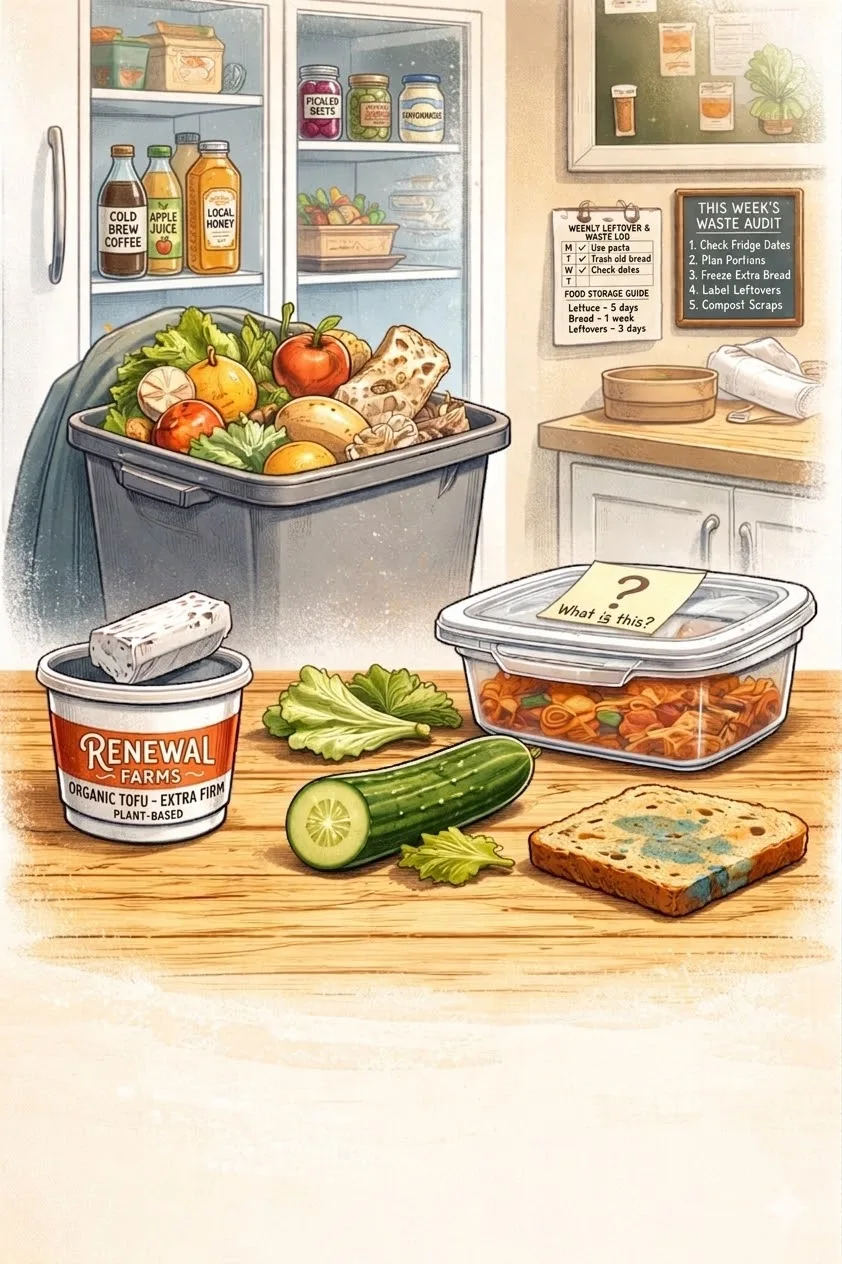
- half a cucumber that never got a plan
- leftovers nobody labeled
- bread bought with good intentions and lost to a busy week
UNEP's global estimate shows that households make up the largest part of consumer-level food waste.
UNEP estimated that 60% of consumer-level food waste happened in households, compared with 28% in food service and 12% in retail.
Source: UNEP Food Waste Index Report 2024, estimate for 2022
The per-person split makes it easier to picture
Big numbers can feel too huge to understand, so the per-person split helps a lot.
UNEP's estimate breaks 132 kg per person into:
- 79 kg in households
- 36 kg in food service
- 17 kg in retail
That means the home slice is not only the biggest. It is more than double the retail slice.
It also means the average household share works out to about 6.6 kg a month, or roughly 1.5 kg a week, per person. You do not need a mountain of spoiled food to reach that number. A few small misses each week can do it.
If you want the wider global picture behind these numbers, the Chefito post on how much food is wasted in the world gives the full big-picture version in simple language.
The per-person view makes the household problem feel more real and easier to picture.
UNEP's 2022 estimate breaks consumer-level food waste into 79 kg per person in households, 36 kg in food service, and 17 kg in retail.
Source: UNEP Food Waste Index Report 2024, estimate for 2022
The EU snapshot looks almost the same
When you zoom into Europe, food waste by sector keeps the same basic shape.
Eurostat says the EU generated 58.2 million tonnes of food waste in 2023. That works out to about 130 kg per person. More than half of that, 53%, came from households.
The rest was spread across the supply chain:
- 24 kg per person from manufacturing
- 14 kg from restaurants and food services
- 12 kg from primary production
- 10 kg from retail and distribution
So even though food waste shows up everywhere, home routines still matter most.
Eurostat's per-person sector view still puts households clearly in first place.
Eurostat said the EU wasted about 130 kg of food per person in 2023, including 69 kg in households, 24 kg in manufacturing, 14 kg in restaurants and food services, 12 kg in primary production, and 10 kg in retail and other distribution.
Source: Eurostat, food waste by main economic sectors in the EU, 2023
The U.S. picture points the same way
The U.S. number is reported differently, so it should not be stacked beside the UNEP and Eurostat figures like it is the same kind of chart.
USDA uses a broader food-system estimate and says that 30% to 40% of the food supply goes uneaten.
That is not a neat apples-to-apples comparison. But it points in the same direction as the other sources: too much good food never becomes a meal, and homes are still one of the most important places to change that.
What "good" looks like at home
This is the part people often get wrong.
"Good" does not mean:
- a perfect fridge
- no leftovers ever
- zero food thrown away for the rest of your life
Good usually looks much simpler:
- you know what is already at home before shopping
- you can spot the urgent food fast
- leftovers have a date
- opened food does not turn into a mystery
- you freeze food early instead of late
That is what a real kitchen system looks like.
Kids can understand this version too:
If food stays visible, it is much more likely to get eaten.
If food turns into a surprise, it is much more likely to get wasted.
A better home target than "be perfect"
The most useful home target is not perfection. It is fewer surprises.
That can mean:
- one quick fridge check before shopping
- one use-first shelf or basket
- one rescue meal each week
- one freezer save before food becomes doubtful
Those are small habits, but they attack the exact places where household waste usually begins.
Why this is actually hopeful
These numbers can sound heavy at first, but they also bring good news.
If homes create the biggest share of food waste, then home habits are one of the strongest levers too.
That means progress does not need to start with a giant policy meeting or a perfect lifestyle makeover.
It can start with:
- seeing what is already there
- using the most urgent food first
- planning one meal around real ingredients
- buying only the gaps
That is much more doable than trying to become a different person overnight.
If you want the practical next step after this article, planning meals around what you already have is one of the easiest ways to turn these numbers into less waste.
A gentle Chefito shortcut
Chefito helps with the memory part of the problem.
It gives you one place to see what is in the kitchen, what should be used first, and what is already open. That makes it easier to turn numbers like these into calmer daily habits.
The app does not need to make you perfect. It just needs to help you waste less food this week than last week. That is already real progress.
If you want a practical home system instead of just another statistic, download Chefito and use it to see urgent food before it turns into waste.
And if dates are part of the problem in your kitchen, tracking expiry dates in Chefito is the next useful read.
FAQ
Which sector wastes the most food?
In the latest UNEP global estimate, households are the biggest sector, with 60% of consumer-level food waste.
How much food waste happens at home?
UNEP estimated 79 kg per person in households globally in 2022. Eurostat estimated about 69 kg per person from households in the EU in 2023.
Is food waste mostly a supermarket problem?
No. Shops matter, but the latest global and EU data both show that homes are the biggest slice.
What does "good" look like at home?
It looks like fewer surprises: knowing what is in the fridge, using urgent food first, labeling leftovers, and freezing food before it becomes risky or forgotten.
Should I compare country numbers directly?
Only carefully. Different sources do not always measure the same stages in the same way, so broad comparisons need context.
Try the workflow
Ready to track your pantry instead of guessing?
Download Chefito to keep food dates visible, plan from your actual stock, and build a clearer shopping list.
Free to download. Paid upgrades, if chosen, are handled by Apple or Google.