
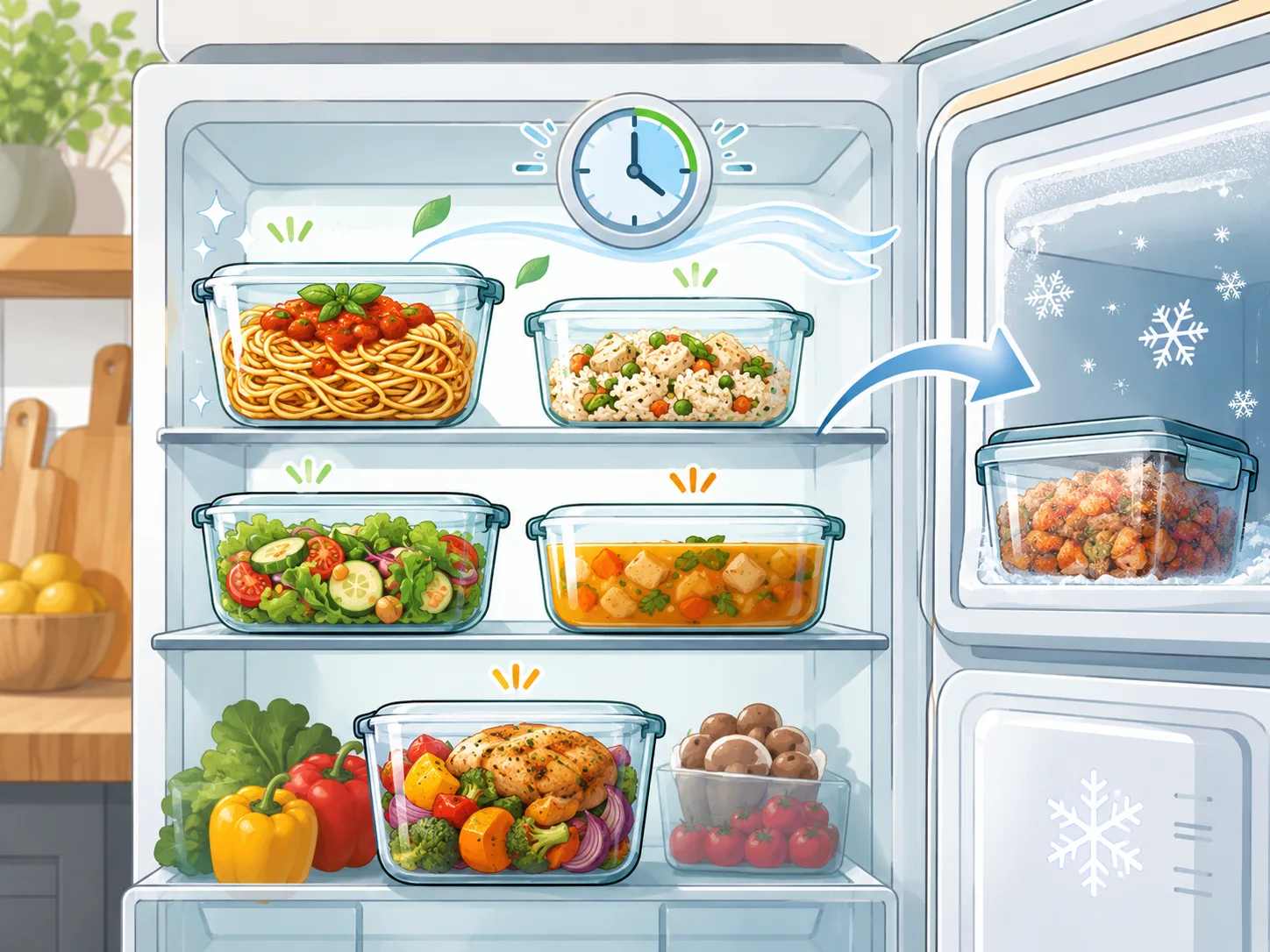
How Long Do Leftovers Last in the Fridge?
How long leftovers last in the fridge, when to freeze them, and how to stop relying on guesswork.
How long do leftovers last in the fridge?
Most leftovers should be cooled quickly, refrigerated within 2 hours, and eaten soon.
Across food-safety advice, the first rule is very consistent. WHO says cooked food should not stay at room temperature for more than 2 hours and should be refrigerated quickly, preferably below 5 C.
Where advice changes is the fridge window afterward. In the UK, Food Standards Agency advice is stricter and tells households to eat leftovers within 2 days or freeze them. In the U.S., many official charts allow 3 to 4 days for several common cooked leftovers.
If you want one simple rule that feels safer across countries, 48 hours is a good default unless your local food authority says otherwise for that food.
The two numbers that matter most
WHO keeps the first part simple:
- refrigerate food within 2 hours
- keep cooked food below 5 C once chilled
UK advice then adds the simpler home rule: eat leftovers within 2 days or freeze them if that will not happen.
That is why "I will eat it sometime" is not a system. A real date still matters.
These two numbers give a simple Europe-first home rule for many leftovers.
FSA advice says cool leftovers and refrigerate within 2 hours, then eat them within 48 hours or freeze them.
Source: Food Standards Agency, Cooking your food
Why official advice sounds different across countries
This is the part that confuses people online.
European and UK guidance often gives a stricter household rule because it is easier to remember and safer to follow on busy days. U.S. cold-storage charts are more item-specific, so many cooked leftovers show up as 3 to 4 days in the fridge when they have been cooled and stored well.
Those are not totally opposite messages. They are different ways of helping people make decisions:
- Europe-first advice gives a simpler home rule
- U.S. guidance gives more food-by-food detail
If you want the low-stress version that still respects both, use 48 hours as your default decision point and freeze earlier if life is getting in the way.
USDA refrigerator guidance: how long leftovers are good in the fridge
If you search this question online, you will often see USDA-style answers saying many cooked leftovers are good for 3 to 4 days in the refrigerator.
That is a real official rule in the United States.
But if you are in Europe, especially if you follow UK-style food advice, the simpler and safer answer is:
- chill within 2 hours
- keep the fridge below 5 C
- eat within 2 days or freeze
That is the better starting point for Chefito's audience.
Not all leftovers behave the same way
Official U.S. cold-storage charts are still useful because they show why "leftovers" is not one single category.
Many cooked leftovers such as:
- soups and stews
- casseroles
- cooked meat or poultry
- cooked pizza
often land in that 3-to-4-day fridge range when stored correctly.
That does not mean every container in your fridge deserves the full window. It means the food type, the cooling speed, and your fridge temperature all affect how much trust you can put in the calendar.
Europe-first household advice is stricter, while U.S. charts often give a longer food-specific range.
FSA says cool leftovers within 2 hours and eat them within 2 days or freeze them. Many U.S. cold-storage charts list 3 to 4 days for common cooked leftovers.
Source: Food Standards Agency household leftovers advice and FoodSafety.gov cold storage charts
Why leftovers get wasted so easily
Leftovers usually start with a good intention.
Someone cooks extra to make tomorrow easier. Then tomorrow gets full. The container slides backward. Another meal wins. A few days later nobody feels confident enough to eat it.
That is where waste and worry meet each other. People do not only forget the food. They forget when it was made.
Cooling and storage change everything
Safe leftover time starts right after the meal, not three days later.
WHO Europe says a refrigerator set below 5 C protects most foods, but not indefinitely. It also recommends dividing large pots of food into small portions and shallow containers before refrigerating.
A simple safe-storage routine looks like this:
- portion leftovers soon after the meal
- use shallow containers when possible
- cover them well
- label them with the date
- refrigerate promptly
The longer food sits out, the less useful the calendar date becomes.
A day 0 to day 4 workflow that actually helps
Even if you follow the stricter Europe-first rule, it helps to think of leftovers as a short workflow instead of one vague deadline.
- day 0: cool, portion, label, refrigerate
- day 1: easiest lunch or backup dinner
- day 2: last easy Europe-first day
- day 3: either use now or rely only on local guidance you trust
- day 4: usually already beyond the comfort zone for a simple home rule
This is why freezing early works so well. It gives you a clean exit before the container becomes a question mark.
The 3-to-4-day rule is a planning tool too
This rule is not only about safety. It is also great for reducing waste because it creates an action window.
- day 1: cool, store, label
- day 2: easy lunch or dinner
- day 3: commit to using it
- day 4: last comfortable fridge day for many leftovers
If you already know you will miss that window, freezing early is the smarter move.
Freezing is a rescue move, not a failure
People sometimes treat freezing as if the original plan already broke.
It did not.
Freezing is what good planning looks like when your next few days are full. FSA advice says to freeze leftovers if eating them within 2 days is unlikely.
Reheat properly, not casually
The storage window is only part of the system.
Food also needs to be reheated properly. FSA guidance says leftovers should be reheated until steaming hot throughout, not just warmed a little at the edges.
So the practical loop is:
- cool quickly
- refrigerate quickly
- eat soon or freeze
- reheat thoroughly
What if the container smells fine?
Smell helps, but smell is not enough.
A normal smell does not tell you:
- how long the food was in the danger zone
- whether it sat out too long before chilling
- how many days it has really been in the fridge
The better question is not "Does this seem okay?"
The better question is "How long has this been here, and how was it stored?"
A simple leftovers routine
Try this after dinner:
- pack leftovers before the kitchen close-down feeling starts
- write the day on the container
- keep the container visible
- plan one leftovers meal in the next 48 hours
- freeze anything you probably will not eat in time
This routine is plain. That is exactly why it works.
Some households should use the stricter margin
If someone in the household is pregnant, older, immunocompromised, or otherwise more vulnerable to foodborne illness, the safer choice is to follow stricter local guidance rather than stretching a leftovers window because the container still looks okay.
A gentle Chefito shortcut
Chefito can help you log leftovers, keep the most urgent items visible, and stop cooked food from becoming an anonymous box in the fridge. It does not replace food-safety rules, but it does make the 2-hour and 3-to-4-day rules much easier to follow.
If you want that system ready before your next batch-cooking session, download Chefito and use it to log leftovers while they still have a clear date and plan.
If leftovers always feel risky too early, check safe fridge temperature next because storage temperature is often the hidden problem.
FAQ
How long do leftovers last in the fridge?
For a Europe-first answer, use 2 days as the simpler safer home rule and freeze sooner if needed. You will also see 3-to-4-day advice in some other countries, including the U.S.
When should leftovers go into the fridge?
Within 2 hours.
Can I eat 5 day old leftovers?
If you follow the simpler Europe-first home rule, 5 days is already too long for many leftovers in the fridge. Freeze earlier if you will not eat them in time.
Should I freeze leftovers if I will not eat them soon?
Yes. Freezing early is usually much better than waiting until you no longer trust the food.
Try the workflow
Ready to track your pantry instead of guessing?
Download Chefito to keep food dates visible, plan from your actual stock, and build a clearer shopping list.
Free to download. Paid upgrades, if chosen, are handled by Apple or Google.


Sources
- Five keys to safer food
WHO
- How to chill, freeze and defrost food safely
Food Standards Agency
- Food and You 2: Wave 10 Key Findings
Food Standards Agency
- Cooking your food
Food Standards Agency
- Cold Food Storage Chart
FoodSafety.gov