
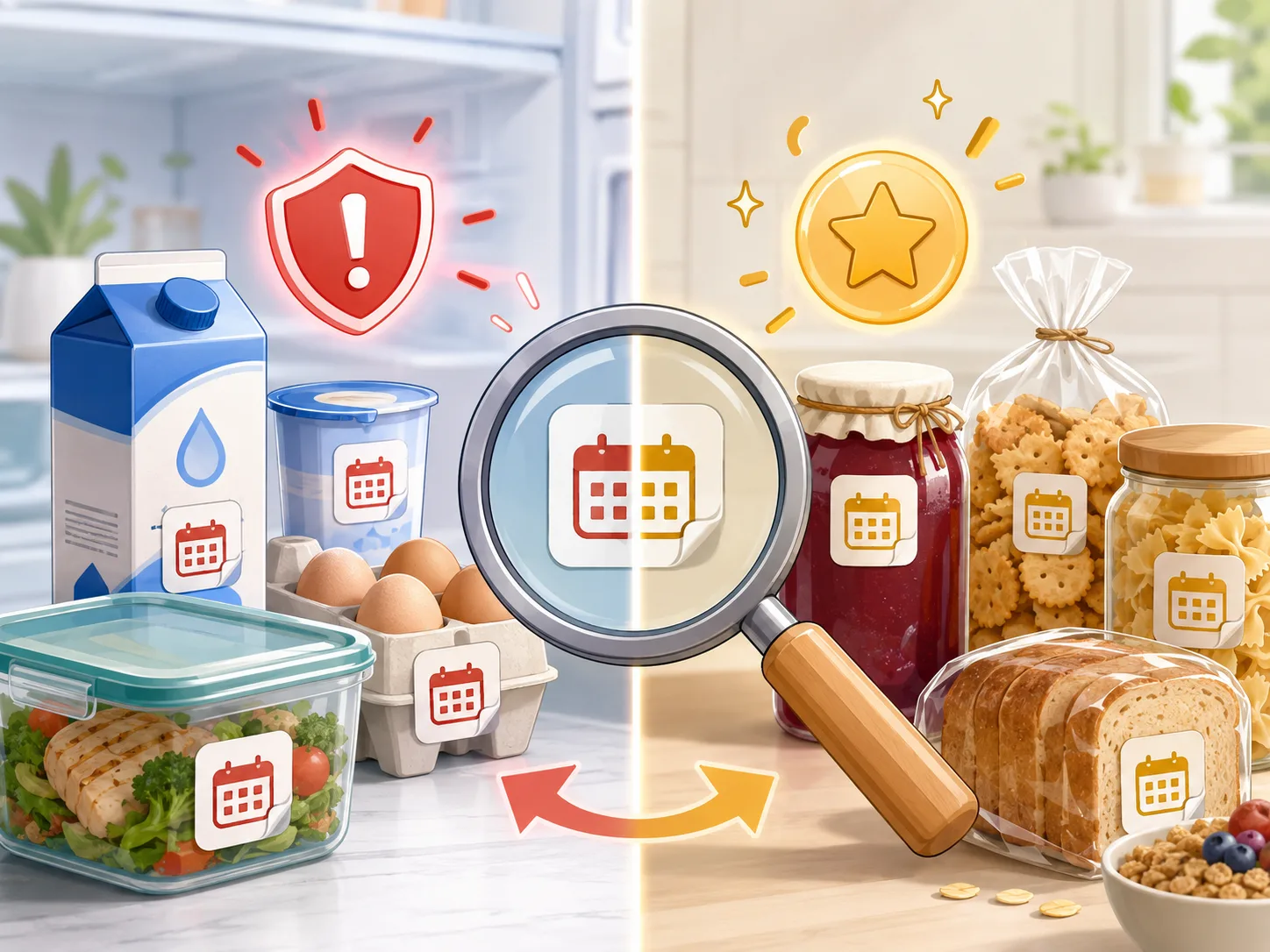
Food Date Labels Explained: Best Before vs Use By
Food date labels feel confusing until you split best before, use by, and the quality-versus-safety difference.
Food date labels explained quickly
Most food date labels are about quality, not safety, but only if you know which kind of date you are looking at.
That sounds small, but it has a big effect. The European Commission estimates that up to 10% of food waste in the EU each year is linked to date marking.
So this is not just a labeling issue. It is a confidence issue. When people do not know what a date means, they often throw food away early just to feel safe.
Why date labels create so much confusion
Across countries, packages can still use a mix of phrases, but in Europe the main dates people see are much clearer:
- use by
- best before
Those two labels do different jobs.
The European Commission and the Food Standards Agency both make the split very clear:
- `use by` is about safety
- `best before` is about quality
Date labels affect waste when people do not know whether a date is about safety or quality.
The Commission says up to 10% of food waste in the EU is linked to date marking.
Source: European Commission, date marking and food waste prevention
Best before vs use by: the most important split
A food date label is not one thing.
In Europe, the important split is this:
- `use by` tells you the food may become unsafe after that date
- `best before` tells you the food may lose quality after that date
That is why the same calendar date can lead to very different decisions depending on which label is on the pack.
The quickest EU-UK-US translation table
If you read food labels across countries, the same food can look much more confusing than it really is.
Use this simpler translation instead:
Safety date. Do not treat it as optional.
- EU: `use by`
Quality date. Think about storage and quality changes, not only the printed date.
- EU: `best before`
The same core split as the EU. The Food Standards Agency treats `use by` as safety-critical.
- UK: `use by` / `best before`
The wording is less standardized for everyday decisions, so storage history and official cold-storage guidance matter much more.
- U.S.: `best by`, `best if used by`, `use by`, `sell by`
That is why a U.S. reader searching for "what does best by mean" often needs a calmer answer than "the food expired." Many American date phrases are more about freshness or peak quality than a universal safety deadline.
These two signals help explain why date labels still cause hesitation and waste in real kitchens.
The market study found about 96% of products reviewed carried a use-by or best-before date, while about 11% showed poor legibility. These are separate indicators, not parts of one total.
Source: European Commission market study on date marking
Quality is not the same as safety
This is the part worth slowing down for.
Quality answers questions like:
- Will this still taste its best?
- Will the texture still feel right?
- Will it still look as fresh?
Safety answers a different question:
- Could this make someone sick?
A cereal box that is past its best date may be stale. That is mainly a quality issue.
Cooked chicken that sat too long in the fridge is a safety issue.
The package date does not settle both questions at once.
What the common labels usually mean
Here is the simple version.
Best if used by
Usually about peak flavor or quality. Food may still be fine after this date if it was stored properly.
Use by
In Europe, this is the safety date. The FSA says not to eat food after the use-by date even if it looks and smells fine.
Opened and unopened are not the same reality
A printed date helps most when the food is still in the condition the producer expected.
That starts to break the moment something is opened.
- an unopened yogurt is not the same as a yogurt that has been open for days
- a sealed sauce jar is not the same as a jar used all week
- a printed best-before date does not describe how warm your fridge has been
This is one reason date labels get misunderstood. The package shows one part of the story. Your storage history shows the rest.
The safest simple reading
If you want one practical rule set that works well for most readers, start here:
- `use by` means safety
- `best before` means quality
- U.S.-style `best by` wording usually needs storage context, not panic
Once you start there, the label becomes much easier to use correctly.
What a printed date cannot tell you
Even a clear label still leaves out some of the most important information:
- what kind of food it is
- whether it stayed cold enough
- how long it has been open
- whether it sat out too long
- whether it now shows real spoilage
That is why storage history matters so much. A printed date on unopened yogurt does not answer the same question as a container of cooked rice made four days ago.
A calmer way to decide
If you are unsure about a food, walk through this order:
1. Understand whether it is `use by` or `best before`
That is the first question to ask.
2. Think about storage
Was it kept cold? Was it left out? Was it opened days ago?
3. Check trusted storage advice
FoodSafety.gov and other official cold-storage charts are much more useful than guessing.
4. Then look for spoilage
Bad smell, texture, mold, or obvious damage matter. But for foods with a `use by` date, smell is not enough to undo the safety warning.
Why this matters for food waste
When every date feels like an emergency, safe and usable food gets thrown away too early.
That means:
- more waste at home
- more money lost
- more stress around everyday decisions
Clear labels help, but clear routines help too.
A gentle Chefito shortcut
Chefito cannot decide food safety for you, but it can reduce the memory problem around dates.
It helps you track what came home, what was opened, and what should be used first. That means fewer decisions are made in a fog, and fewer items get thrown away only because nobody remembers the context.
If you want that routine in your pocket, download Chefito and use it to keep opened food, use-first items, and shopping decisions in one place.
If dates are the part you want to operationalize next, how to track expiry dates in Chefito is the best follow-up.
FAQ
What is a food date label?
Usually it is either a `use by` date for safety or a `best before` date for quality.
Is the date on food always a safety deadline?
No. In Europe, `best before` is about quality, while `use by` is about safety.
What does `best by` mean?
Usually it points to best quality, not automatic danger. In the U.S. especially, you still need to think about storage history and the type of food.
What is the difference between use by and best before?
`Use by` is about safety. `Best before` is about quality.
If the date passed, should I throw the food away right away?
Not automatically. First think about the food type, storage temperature, whether it was opened, and what trusted storage advice says.
Try the workflow
Ready to track your pantry instead of guessing?
Download Chefito to keep food dates visible, plan from your actual stock, and build a clearer shopping list.
Free to download. Paid upgrades, if chosen, are handled by Apple or Google.


Sources
- Date marking and food waste prevention
European Commission
- Best before and use-by dates
Food Standards Agency
- Labelling
European Commission
- Market study on date marking and other information provided on food labels and food waste prevention
European Commission
- Cold Food Storage Chart
FoodSafety.gov