
When a Kitchen Stops Fitting in One Person's Head
What Chefito does, and why Pro and Pro+ can feel genuinely worth it once a kitchen gets busy.
The short answer
Chefito is built around one very practical idea: start with the food that is already at home.
That sounds small, but it changes everything.
The latest UNEP estimate says the world wasted about 1.05 billion tonnes of food in 2022, and 60% of that consumer-level waste happened in households. In the EU, the European Commission says households still generate the biggest slice of food waste, about 69 kg per person a year.
So if a kitchen app wants to help in real life, it cannot only be a place to save recipes or make nice plans. It has to help with the ordinary moments where waste actually begins:
- the receipt that never gets added
- the yogurt nobody noticed
- the half-opened sauce that became invisible
- the spinach bought for one meal and forgotten by Thursday
- the shared kitchen where everybody assumes somebody else is keeping track
That is exactly the lane Chefito tries to own.
If the biggest slice of food waste happens at home, better home workflows matter more than people think.
UNEP estimated that 60% of consumer-level food waste happened in households, compared with 28% in food service and 12% in retail.
Source: UNEP Food Waste Index Report 2024, estimate for 2022
Why this matters before we even talk about subscriptions
Food waste is easy to underestimate because it usually looks small at home.
One cucumber. One tub of yogurt. One bunch of herbs. One leftover container no one trusts anymore.
But official data keeps pointing to the same thing: the home kitchen is not a side note.
The European Commission's current food-waste page says the EU generates over 58 million tonnes of food waste a year, around 130 kg per person, with households responsible for 53% of it. The same page also puts the associated market value at 132 billion euros.
That is why this is not only a sustainability topic.
It is also:
- a budget topic
- a time topic
- a mental-load topic
- a household-coordination topic
If the biggest waste problem happens in ordinary kitchens, then the best product logic is not more noise. It is better memory, faster input, clearer priorities, and less friction between "we bought this" and "we actually used this."
Households remained the biggest single source of food waste in the latest EU sector breakdown.
The Commission says the EU generated over 58 million tonnes of food waste in 2023, about 130 kg per person, including 69 kg in households, 24 kg in manufacturing, 14 kg in restaurants and food services, 12 kg in primary production, and 10 kg in retail and other distribution.
Source: European Commission food-waste page citing Eurostat 2025 food-waste reporting for 2023
What Chefito does differently
Chefito begins with what is already in your kitchen.
That means the app is trying to answer a different daily question:
What do we already have, what needs attention first, and what should happen next?
That shows up in a few very specific ways.
It starts with inventory, not wishful thinking
A lot of food waste begins before the cooking starts.
It begins when the household loses the picture of what is already there.
Chefito turns that picture back on:
- inventory by storage location
- expiring items surfaced early
- opened items treated like a new reality
- shopping tied back to what is missing, not what feels familiar
This is why the app feels calmer in a real kitchen. It is trying to reduce surprises.
It treats food state as part of the truth
A sealed carton and an opened carton are not the same thing.
A raw ingredient and a cooked leftover are not the same thing.
A recipe idea and a recipe you can actually cook tonight are not the same thing either.
Chefito is useful because it keeps those states closer to the surface:
- unopened versus opened
- in stock versus urgent
- available versus missing only a few things
- bought versus actually moved into the kitchen
That sounds simple, but it is exactly where everyday waste decisions happen.
It connects the kitchen loop instead of stopping at one step
Chefito is strongest when the loop stays connected:
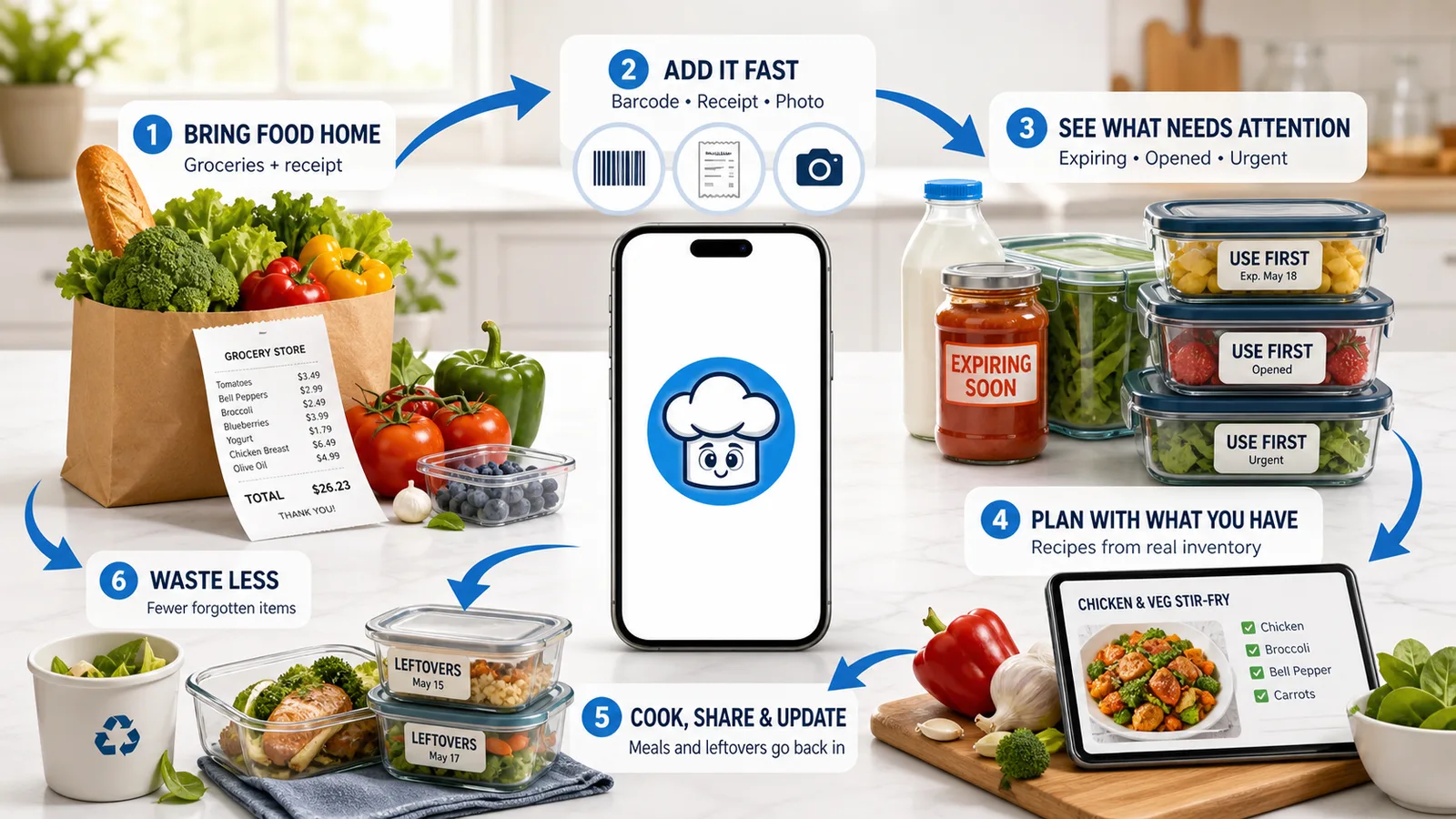
1. food comes home 2. it gets added fast 3. urgent items become visible 4. meal planning uses the real inventory 5. shopping fills only the gaps 6. cooked meals and leftovers update the kitchen again
That loop is what makes the app feel like a kitchen system instead of a storage drawer for information.
Why low-friction input matters so much
This part is more important than it looks.
A small 2022 pilot study on food-waste apps found that users became more aware of waste, but they also said there were too many manual operations for permanent use. They wanted something more complete, with budget visibility, food overview, and fewer steps.
That is a small study, so it should not be treated like final proof for the whole world.
But the direction makes sense.
If logging food feels like homework, people stop.
If getting food into the system feels fast, the system has a chance.
That is why Chefito leans so hard into faster input:
- barcode scan
- receipt scan
- photo-based item extraction
- recipe import from photos, URLs, and images
The goal is not "AI for the sake of AI."
The goal is getting from kitchen reality to useful action before motivation disappears.
The photo matters most before the food disappears
Sometimes the problem is not the receipt. It is the pile of food on the counter:
- tomatoes
- herbs
- mushrooms
- berries
- one dairy item that will go quickly
A fast photo or scan flow matters because these are exactly the foods that get lost to delay. If they get into the app while they are still visible, they are much more likely to become meals.
Where the plans start to separate
Free is a very good starting point for many people.
If you want one personal kitchen, barcode scanning, and a lighter system for the most important foods, Free can already help.
The difference begins when the kitchen stops being small and simple.
That is usually the moment when one of two things becomes true:
- food is coming in faster than anyone wants to type it
- more than one person needs the same kitchen picture at the same time
The plans make more sense when you picture the kitchen shape: just you, a fuller kitchen, or a home that shares one kitchen together.
Read it by kitchen shape
Free stays personal. Pro helps a fuller kitchen move faster. Pro+ is where one paid host can support the whole home.
Just you
Free
Busier days
Pro
Shared home
Pro+
Just you
Free
Best fit
One person keeping track of their own basics
Room
50 tracked items in 1 personal kitchen
Recipes
50 recipes
Getting food in
Manual entry plus barcode scan
AI shortcuts
No AI tools
Planning help
A simple weekly plan with the recipes you already saved
Sharing
Only you. Personal kitchens cannot be joined by other people
Busier days
Pro
Best fit
One person with a fuller kitchen and less time
Room
1,000 tracked items per kitchen, across up to 10 kitchens
Recipes
500 recipes
Getting food in
Barcode scan, AI receipt, and photo input
AI shortcuts
Receipt scan, item photo scan, recipe URL or photo import, expiry and category help, and nutrition scan from photo or file
Planning help
AI recipe help and a bigger recipe space make weekly planning much faster
Sharing
You can create kitchens, but inviting Free users starts in Pro+
Shared home
Pro+
Best fit
A home that wants one shared kitchen picture
Room
1,000 tracked items per kitchen, across up to 10 kitchens
Recipes
500 recipes
Getting food in
Everything in Pro, but better for a shared kitchen
AI shortcuts
All Pro AI shortcuts, now in the kitchen the household shares
Planning help
The same planning help, now with a whole household working from one kitchen
Sharing
One Pro+ host can invite Free users into the kitchens they create
Personal kitchens stay personal
Important: Free includes one personal kitchen, and personal kitchens cannot be joined by other people. Shared household access starts in Pro+ when a host invites Free users into a kitchen.
Source: Chefito subscription terms and current plan rules, checked March 21, 2026
When Free is still enough
Free is enough when the kitchen is still fairly simple.
That can look like:
- one person
- one personal kitchen
- the foods you most want to keep an eye on
- barcode scan as a quick helper
- a simpler habit-building phase before you decide whether you want more
That is a good use of Free. Not everybody needs the bigger system on day one.
Where Pro starts to feel easier
Pro starts to make sense when the pain is no longer "Should I try this app?"
It becomes:
- I do not want to type all this
- I want the receipt to become inventory faster
- I want the weekly plan to come together faster from the food and recipes I already have
- I want recipe help to start from what is actually here
- I want recipes to come in from a link, cookbook photo, or PDF instead of promising I will type them later
- I want meal nutrition to start from a photo when I need it, not from a blank form
- I want the small AI helpers too, like expiry suggestions, category suggestions, and other tiny decisions I do not want to make from scratch every time
- I want the app to keep up with a fuller pantry, freezer, and recipe set
That is the part where Pro stops feeling like a feature list and starts feeling like less friction.
Scenario: the Saturday grocery run
You come home with a full kassenbon, two bags of produce, yogurt, milk, chicken, snacks, and the usual extras.
The weak version of that moment is easy to picture. Everything gets put away fast, nobody wants to type, and by Tuesday the household only remembers half of what came home.
The stronger version is:
- scan the receipt
- let Chefito pull the items in
- check the urgent fresh foods
- let the app help with categories and likely dates instead of filling every little field by hand
- plan around what is now actually in the fridge
That is where Pro starts earning its place. The gain is not only speed in one moment. It is a more honest kitchen picture for the rest of the week.
And Pro is not only about grocery intake.
It also covers the moments when a recipe is sitting in a URL, a screenshot, a cookbook photo, or a PDF and you want it inside your kitchen before the idea disappears.
And if nutrition matters to you, it also helps when a meal photo, menu, label, or receipt can auto-fill the first nutrition draft instead of making you begin from zero.
Scenario: dinner starts from reality instead of memory
One of Chefito's best moments is this:
You open the app and the question is no longer "What sounds good in theory?"
It becomes:
- what is ready now
- what needs to be used first
- what is only one or two ingredients away
- what should go into this week's plan before the fresh food gets forgotten
That is where the paid tools stop feeling decorative. They begin to shorten the distance between groceries and meals.
That is also why Pro can feel worth it even for one person. It is not one big feature. It is many small shortcuts working together:
- receipt scans
- photo scans
- recipe import from URL, photo, or PDF
- expiry and category help
- nutrition scan from a meal photo or file
The annual number is big, but the weekly and monthly view shows why small rescues add up fast.
EPA estimated that a U.S. household of four loses USD 2,913 per year on food that does not get eaten, with an average weekly cost of USD 56. The monthly figure shown here is derived from the annual estimate.
Source: US EPA, Estimating the Cost of Food Waste to American Consumers, published April 4, 2025
Why the money side changes the decision
The U.S. EPA says the average household of four loses about $2,913 per year on food that does not get eaten. That is about $56 a week.
Even if your own home is below that number, the message is still simple:
food waste is expensive long before it feels dramatic.
That is why a paid kitchen tool does not need to save a mountain of food to justify itself.
It only needs to reduce a few of the quiet, repetitive losses:
- produce that never got a plan
- duplicates bought because nobody checked first
- leftovers that became anonymous
- groceries that entered the house but never really entered the system
Where Pro+ changes the household rhythm
Pro+ starts to matter when the kitchen stops belonging to one person.
It is not a separate AI tier.
It is the full Pro shortcut layer, plus the shared-home layer on top.
This is where a lot of households quietly struggle.
The problem is not only food.
It is coordination.
It is the invisible question sitting behind the fridge door:
Who is actually carrying the kitchen in their head?
Scenario: one person has Pro+, the rest stay free
This is one of the clearest Pro+ stories in Chefito.
One person in the household pays for Pro+ and becomes the kitchen host.
Then the rest of the household can stay on Free accounts and still join the shared kitchen.
That means a very normal family setup can work like this:
- one parent has Pro+
- the other adult uses Free
- a teenager uses Free
- everyone sees the same kitchen
- everyone can help update what is bought, used, or missing
That is powerful because the household does not need multiple paid plans just to stay coordinated.
Scenario: the partner who buys milk on the way home
This is a small moment, but it happens all the time.
One person is already at home. Another stops at the shop. A third person is planning dinner.
If the kitchen is shared well:
- the shopping list is already visible
- the bought item can get moved back into the kitchen
- everybody else stops wondering if milk is still needed
That is how Pro+ reduces mental load. It turns one person's memory job into a shared household habit.
Scenario: roommates without group-chat chaos
Shared kitchens tend to break down when updates live in three places:
- one person's head
- a half-remembered text thread
- the fridge itself
Pro+ helps because the shared kitchen becomes the common source of truth. One person can host the kitchen, and the rest can participate without the whole household paying separately just to stay aligned.
Why this matters beyond convenience
Pro+ matters because shared kitchens create shared waste risk too.
When nobody knows what is already open, already bought, or already urgent, the household starts buying duplicates and forgetting the older item first.
That is why shared visibility is not a luxury.
It is a waste-reduction tool.
And it is a relationship tool too, because a calmer kitchen usually means fewer tiny, repetitive check-ins:
- do we still have eggs
- who bought yogurt
- why is there another bag of spinach
- did somebody open this already
Those are small questions, but they add up fast in busy homes.
So which plan is the right one?
The calm answer is:
- choose Free if you want one personal kitchen, a simple routine, and room to build the habit first
- choose Pro if the real pain is typing, forgetting, and managing a fuller kitchen with more speed
- choose Pro+ if your kitchen is shared and you want one paid host to support a whole household with Free members invited in
That is the cleanest way to think about it.
Not as status.
As fit.
The real reason Chefito can feel worth paying for
The best kitchen tools do not win because they look clever.
They win because they help at the exact moment a household is most likely to lose track:
- right after shopping
- midweek when produce is getting softer
- when leftovers need a plan
- when the shopping list should be gap-only
- when more than one person touches the same kitchen
Chefito is trying to be useful in those moments.
That is what makes it feel different.
It is built around the food you already paid for, the meals you can still rescue, and the household rhythm you actually live in.
If you want the big-picture numbers behind that idea, our post on how much food is wasted in the world is the best next read. And if dates are your weak point, how to track expiry dates and use-first items in Chefito goes deeper into the day-to-day workflow.
FAQ
Is Chefito Pro worth it if I live alone?
It can be, especially if you buy enough groceries and save enough recipes that receipt scan, item photo scan, recipe URL or image import, nutrition scan from photo, expiry help, category help, and larger limits will actually save you time every week.
When is Chefito Pro+ worth it?
Pro+ is easiest to justify when one kitchen is shared by partners, families, or roommates and one paid host wants to invite Free users into that shared kitchen while keeping all the Pro AI shortcuts available in the same household workflow.
Can one family member have Pro+ and the rest stay Free?
Yes. That is one of the strongest Pro+ use cases in Chefito's current plan design.
Does Chefito only help with tracking?
No. The stronger value is the full kitchen loop: add food fast, spot what is urgent, plan meals from what is already there, and shop only for the gaps.
Is the weekly plan itself a Pro feature?
The weekly plan matters at every tier, but Pro makes it far more useful when the kitchen gets busy because AI recipe help, faster input, and a larger recipe space make it much easier to plan from reality instead of memory.
Why does scanning matter so much?
Because the easier it is to get food into the system, the more likely the system stays accurate enough to prevent waste.
Try the workflow
Ready to track your pantry instead of guessing?
Download Chefito to keep food dates visible, plan from your actual stock, and build a clearer shopping list.
Free to download. Paid upgrades, if chosen, are handled by Apple or Google.


Sources
- Food Waste Index Report 2024
UNEP
- Towards Zero-Waste and Circular Cities: Key Findings of the Food Waste Index Report 2024
UNEP
- Food waste
European Commission
- Estimating the Cost of Food Waste to American Consumers
US EPA
- Preventing Wasted Food at Home
US EPA
- Food waste prevention and reduction: Practices, cultural and personal determinants
PubMed
- The Impact of Smartphone Apps Designed to Reduce Food Waste on Improving Healthy Eating, Financial Expenses and Personal Food Waste
PubMed