How Much Money Do Families Lose from Wasted Food?
The cost of wasted food is easier to understand when you stop looking at the yearly shock number and start looking at the weekly leak.

In this article
How much money does food waste cost a family?
Food waste rarely feels expensive in the moment.
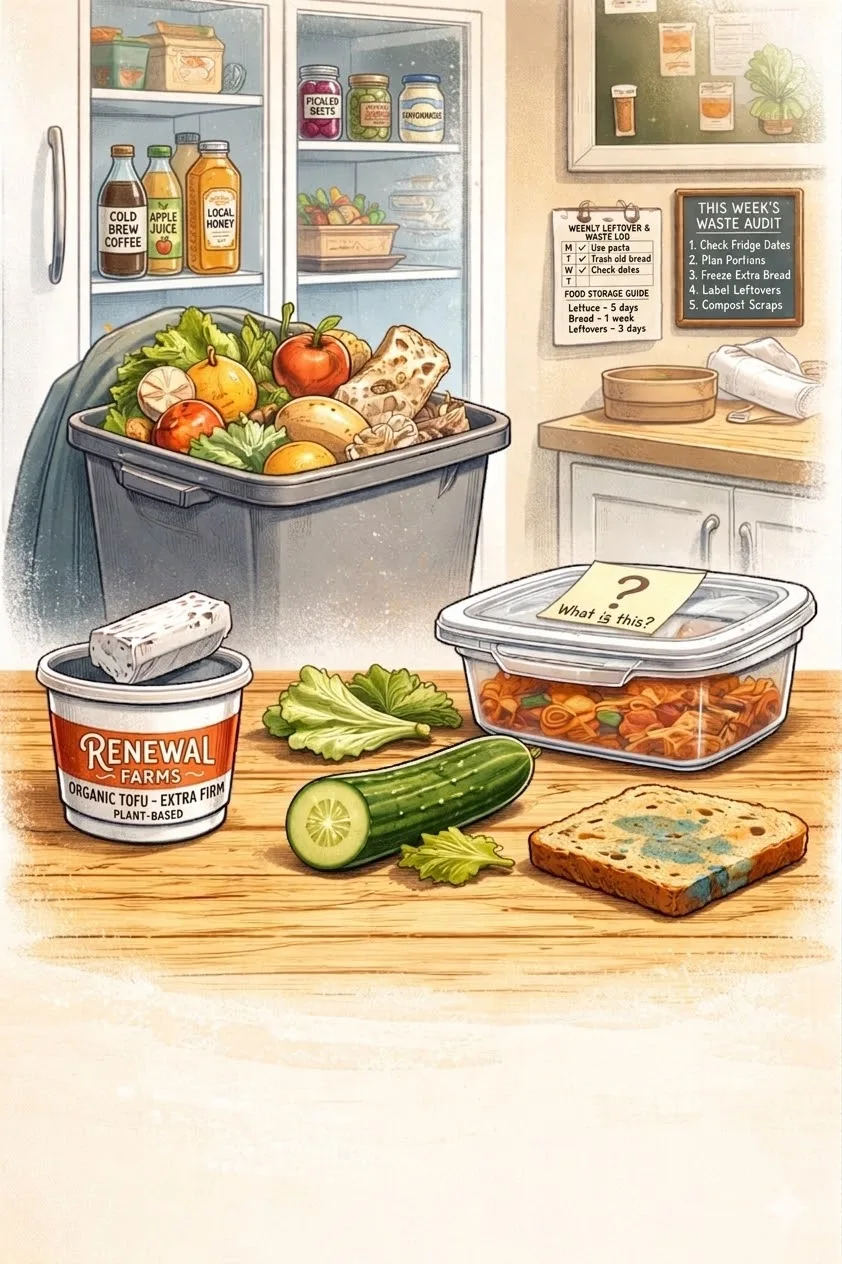
It is one soft cucumber. One forgotten yogurt. One container of leftovers that nobody wants to open because it has already entered the danger zone of "maybe still fine, maybe not."
But grocery money does not usually disappear in one dramatic kitchen disaster.
It disappears quietly.
A few euros here. A few dollars there. One extra shop because dinner plans changed. One bag of salad bought twice because the first one was hiding behind the milk.
The U.S. EPA's 2025 estimate makes that leak easier to picture. It estimates that consumer food waste costs each U.S. consumer about USD 728 per year. For a household of four, that becomes USD 2,913 per year, or about USD 56 per week.
That does not mean every family in every country loses the same amount. Food prices, household size, cooking habits, shopping routines, and eating-out patterns all change the final number.
But the pattern is very steady: when food is bought and not eaten, the household pays twice.
First at checkout.
Then again when that same food ends up in the bin.
The annual cost is large, but the weekly number is the one a household can plan around.
EPA estimated USD 2,913 per year for a U.S. household of four, with an average weekly cost of USD 56. The monthly figure shown here is derived from the annual estimate.
Source: US EPA, Estimating the Cost of Food Waste to American Consumers, April 2025
The important number is not the annual one
Big yearly numbers can feel too abstract.
USD 2,913 sounds like something from a government report. USD 56 a week sounds like a real grocery trip.
That weekly view is more useful because food waste usually happens in weekly patterns too:
- shopping without checking what is already home
- buying fresh food for meals that never happen
- cooking more than the week can realistically absorb
- letting leftovers turn into mystery boxes
- missing the two or three items that should be eaten first
That is why the fix usually does not start with a huge lifestyle reset.
It starts with making the next shopping list a little less blind.
Why the old food-waste cost number got too low
For years, many U.S. campaigns used a familiar estimate: a family of four loses about USD 1,500 per year to uneaten food.
That number was useful, but it was built on older price data.
The EPA's newer report explains why the estimate needed an update. Food prices changed a lot after the older USDA analysis. The 2025 EPA estimate uses more recent USDA food availability data and 2023 retail price data, then estimates the price paid for edible food that was not eaten.
That is the data-science part in plain English:
- estimate how much edible food is not eaten
- group it by food type
- apply food prices to those wasted amounts
- scale the result to a person or household
It is still an estimate.
It is not a perfect receipt-by-receipt truth for your kitchen. But it is much closer to today's grocery reality than the older shortcut.
What other countries show
The money number changes by country.
The problem does not.
WRAP's UK household food-waste material puts the cost at about GBP 17.2 billion per year, equal to around GBP 1,000 per year for a household of four.
Ireland's Environmental Protection Agency says Irish households waste over 220,000 tonnes of food each year and that households spend about EUR 700 a year on food that is wasted.
These are not interchangeable numbers.
Please do not convert them into one global ranking. They come from different countries, methods, currencies, prices, household structures, and food systems.
But together they point to the same boring, expensive truth:
Household food waste is not only an environmental issue.
It is also a budget issue.
These examples use local currencies and local methods, so read them as signals rather than a ranking.
The U.S. example is USD for a household of four. The UK example is GBP for a household of four. The Ireland example is EUR for an average household. Currencies and methods are not directly comparable.
Source: US EPA 2025, WRAP 2024 slides, Environmental Protection Agency Ireland 2025
Food inflation makes the leak feel bigger
Food waste has always cost money.
But it hurts more when groceries are expensive.
Eurostat's consumer price summary shows that food and non-alcoholic beverages had the biggest EU price increase among major consumer categories between 2016 and 2025, rising 33.2%.
That matters because food waste is tied to replacement.
If the spinach goes bad, you may buy more spinach.
If the chicken is forgotten, dinner still needs solving.
If the bread molds, breakfast does not politely cancel itself.
So the real cost is not only:
"that food went to waste."
It is also:
"we had to buy again because the plan broke."
When grocery prices rise, the same forgotten food becomes a bigger budget leak.
Eurostat reports that food and non-alcoholic beverages had the highest increase among major HICP headings in the EU between 2016 and 2025.
Source: Eurostat consumer prices - inflation summary, 2016 to 2025
The highest-value fix is knowing what must be eaten first
Many people try to save money by looking for cheaper food.
That can help.
But it is not the only lever.
Another powerful lever is eating more of the food you already paid for.
This is where the kitchen gets very practical. The most useful question before shopping is not:
"What do we feel like buying?"
It is:
- what is already open?
- what expires soon?
- what fresh food is hiding?
- what leftovers need a plan?
- what meals can use those items first?
That question changes the whole topic.
Food waste stops being a guilt problem.
It becomes an inventory problem.
And inventory problems are much easier to fix than guilt.
A simple weekly food-waste budget
If you want a calmer way to use the EPA number, do not start by trying to save USD 2,913.
Start with one week.
Try this:
- choose one use-first shelf or fridge bin
- check it before every shopping trip
- plan two meals around food already at home
- freeze leftovers before they become suspicious
- write down the one item you waste most often
That is enough to change the direction.
If your household saves even a small part of the weekly leak, the annual number starts moving by itself.
That is the nice part about food-waste math.
You do not need a perfect kitchen for the numbers to improve.
You need a kitchen that forgets a little less often.
Why families lose money even when they are careful
Food waste is not usually laziness.
Most of the time, it is coordination failure.
One person buys groceries. Another person changes dinner plans. Someone opens a sauce but nobody remembers when. A child suddenly stops liking bananas with the confidence of a tiny food critic. A container goes into the fridge with no date and slowly becomes archaeology.
That is normal kitchen life.
The problem is that normal kitchen life gets expensive when there is no shared memory for it.
A household does not need to be chaotic to waste food.
It only needs to lose track.
Where Chefito fits
Chefito is useful here because it treats the kitchen like a small system, not a moral test.
You can track what came home, mark what is open, see what should be used first, plan meals around existing food, and build a shopping list from what is actually missing.
That does not magically remove waste.
No app can make a tired Tuesday behave.
But it does reduce the number of kitchen decisions made from memory.
And memory is exactly where a lot of grocery money quietly disappears.
If you want to make the next shop less blind, download Chefito and start with the food you already have.
If you want the best next read, try how to plan meals with what you already have or how to track expiry dates in Chefito.
FAQ
How much money does food waste cost a family of four?
In the U.S., the EPA's 2025 estimate puts the cost at USD 2,913 per year for a household of four, or about USD 56 per week. Other countries use different methods and prices, so local estimates will vary.
Is the USD 2,913 number only groceries?
No. The EPA estimate covers consumer food waste from food bought for home and away-from-home consumption, such as restaurants and prepared foods. It estimates the price paid for edible food that was not eaten.
Why do food-waste cost estimates differ by country?
They use different datasets, food prices, household sizes, and definitions. The safest way to read them is as local examples, not a global ranking.
What is the easiest way to save money by wasting less food?
Check what you already have before shopping, plan around the most urgent items first, and freeze leftovers early if they will not be eaten soon.
Does reducing food waste mean buying less food?
Sometimes, but not always. Often it means buying with better timing, using opened items first, and avoiding duplicate groceries.
Ready to track your pantry instead of guessing?
Download Chefito to keep food dates visible, plan from your actual stock, and build a clearer shopping list.
Sources
- Estimating the Cost of Food Waste to American Consumers
US EPA
- Consumers
USDA
- Household Food Waste Working Group Slides
WRAP
- EPA has five easy steps for people to reduce food waste and save money
Environmental Protection Agency Ireland
- Consumer prices - inflation
Eurostat