
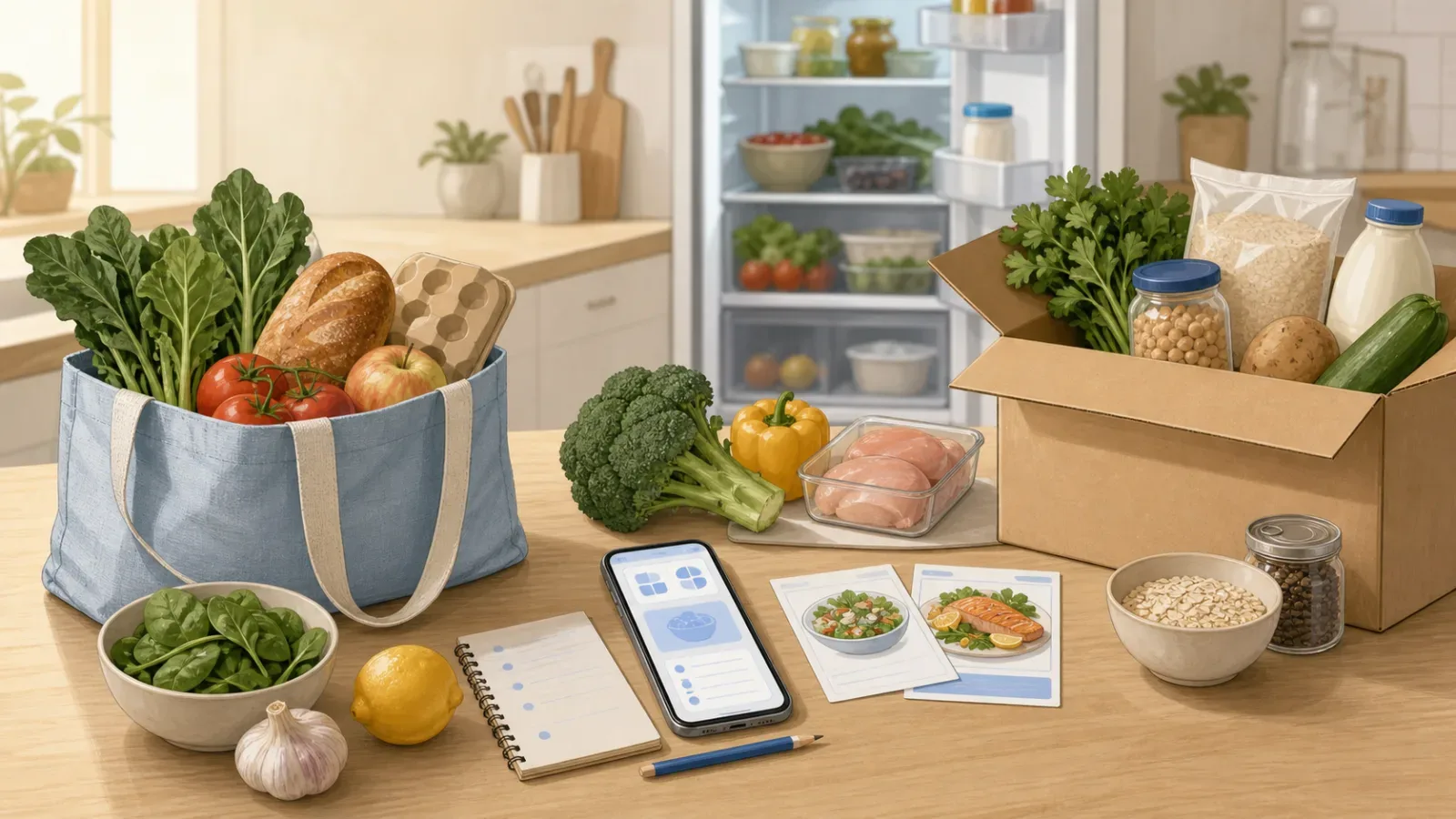
Grocery Delivery or Shopping in Person? The Better Question Comes Before Checkout
Delivery can save time and make food access easier. Shopping in person can offer more control. The real difference often begins before checkout, with what your kitchen already knows.
Grocery delivery can save time and make food access easier. Shopping in person can offer more control and flexibility. But neither option can solve a kitchen that has lost track of what it already contains.
The grocery delivery arrives exactly when promised.
Inside the bags are vegetables for three ambitious recipes, another bottle of olive oil, two yoghurts that are already sitting in the fridge and a substitute ingredient nobody quite knows what to do with.
The delivery worked perfectly.
The kitchen plan did not.
That distinction matters. Because the most important question may not be whether groceries arrive at your door or come home in a reusable bag.
It may be whether the purchase was connected to what you already had, what you genuinely intended to cook and what needed to be used first.
The short answer
Grocery delivery can remove travel, queues and carrying. It can make everyday life significantly easier for people with irregular schedules, mobility limitations, care responsibilities, poor transport connections or simply too little time.
Shopping personally can provide more control over freshness and quality. It also allows you to adapt your plans in the moment and may add some walking, local discovery or social contact.
Neither method is automatically healthier, cheaper or more sustainable.
What matters in both cases is the planning loop surrounding the purchase:
Check what is already at home. Choose meals you will realistically cook. Buy the genuine gaps. Register what arrived. Update the kitchen after cooking.
The checkout method changes.
The need for a plan does not.
Grocery delivery solves real problems
For somebody finishing a late shift, looking after a child, recovering from an injury or living without a car, grocery delivery is not a lazy shortcut.
It may be the difference between getting food into the house and postponing the task for another day.
Research on online grocery shopping repeatedly identifies the same practical advantages: less travel, no queueing, less carrying and the ability to order outside a conventional shopping window. Distance, health and limited mobility can make these benefits especially valuable.
There does not need to be a medical emergency behind the decision, either.
Convenience is a legitimate benefit in its own right. Saving part of an evening can mean more time for rest, family, cooking or absolutely nothing productive at all. That still counts.
People working irregular hours may find delivery particularly useful because food shopping does not always fit neatly around shift patterns. Research shows that shift work can disrupt meal timing and make suitable food harder to access.
That does not prove that delivery automatically improves a shift worker’s diet. It simply means that delivery can make obtaining groceries easier.
What happens after checkout remains a separate question.
And, of course, delivery does not eliminate every inconvenience. Narrow time windows, unavailable products, unsuitable substitutions and support requests can quickly reclaim some of the time that ordering was supposed to save.
Convenience comes with less control
The clearest trade-off is control over the food itself.
When another person selects the groceries, you cannot compare two bunches of herbs, inspect the strawberries from underneath or decide that the tomatoes look disappointing and change dinner accordingly.
Fresh food is not completely standardised. Two avocados with the same product name can have very different plans for the next three days.
Substitutions make this loss of control particularly visible. A replacement may look perfectly reasonable to the person packing the order and still be unsuitable for an allergy, a recipe, a budget or a household that already has three packets of it.
Then there is the online shop itself.
A digital supermarket is not simply a physical shelf placed on a screen. Search rankings, sponsored positions, special offers, suggested alternatives, saved baskets and personalised recommendations all influence what shoppers notice.
Some research has found fewer purchases from particular discretionary categories when people shop online. Other studies show that changing the position or presentation of products can move a digital basket in either a healthier or less healthy direction.
Online shopping therefore changes the architecture of temptation.
It does not remove it.
Other common trade-offs include delivery charges, minimum-order values, possible product mark-ups, delayed deliveries and additional digital records of searches and purchases.
Access can also work in both directions. Delivery may remove a physical barrier while introducing a financial or digital one. A person may struggle with an inaccessible interface, an unsuitable payment method, poor internet access or a service that simply does not cover their area.
What shopping personally can still offer
Shopping in person provides information that is difficult to reproduce through a screen.
You can inspect ripeness, notice damage, compare sizes and change your plan when the available ingredients are better or worse than expected.
That flexibility is particularly useful for fresh food.
Perhaps the courgettes look tired, but the peppers are excellent. Perhaps the fish you intended to buy is unavailable, but another option looks better. A physical shop allows the meal plan to respond immediately to quality and availability.
A shopping trip may also add some everyday movement when it involves walking, cycling or public transport. Research has linked access to nearby grocery destinations with walking in certain populations.
That does not mean grocery shopping is automatically exercise.
Walking five minutes to a local shop is not the same experience as driving across town, circling a car park and rushing through a crowded supermarket after a long working day.
For some people, grocery shopping can also provide a small but meaningful social routine: recognising a cashier, speaking with somebody at a market stall or simply leaving the house and spending time around other people.
Qualitative research suggests that this can be important for some older adults and people living alone.
For somebody else, the same trip may be painful, inaccessible, overstimulating or impossible to fit into the day.
Personal shopping can therefore offer direct quality control, flexible decision-making, incidental movement, brief social contact and opportunities to discover seasonal or local ingredients.
But those benefits only exist when the trip itself is manageable.
The supermarket is not a wellness retreat. Sometimes it is just loud, crowded and out of oat milk.
Does selecting food satisfy an ancient gathering instinct?
Selecting food can feel surprisingly satisfying.
It is tempting to explain that feeling through humanity’s long history of gathering, foraging and provisioning. The story sounds intuitive: our ancestors searched for food, and modern grocery shopping supposedly recreates part of that experience.
The scientific evidence does not support such a direct conclusion.
Research on foraging helps explain how humans and animals make choices under ecological constraints. It does not demonstrate that inspecting tomatoes under supermarket lighting activates an ancestral mechanism that improves modern wellbeing.
There are simpler and more defensible explanations.
Personally selecting food can create a sense of control. It involves visual, tactile and spatial information. It can connect an abstract meal plan with real ingredients. Completing the trip may also provide the ordinary satisfaction of finishing a useful task.
These ideas relate more closely to autonomy, competence, sensory engagement and food agency: the ability to make food decisions within the real constraints of time, money, access and daily life.
“Ancestral gathering” may work as an interesting metaphor.
It should not be presented as a scientific fact.
The bigger difference may happen before checkout
A large French study found that people who planned meals reported better dietary quality and greater food variety.
Another study involving lower-income shoppers in the United States found that using a grocery list was associated with better dietary indicators.
Those findings are useful, but they need to be interpreted carefully.
Both studies were observational. They identified relationships rather than proving that meal planning or list-making directly caused the outcomes. People who plan their meals may also differ in income, available time, cooking confidence, health priorities or household organisation.
Food-waste research nevertheless points toward an important principle.
Waste rarely begins with one spectacularly bad decision. It develops through a series of small disconnects:
food is purchased without checking what is already available ingredients are bought without a realistic meal attached to them attractive recipes exceed the household’s actual cooking capacity fresh products are forgotten behind newer purchases leftovers are stored without a clear plan one household member shops without knowing what another has already bought
That is why the planning loop may matter more than the purchasing channel.
1. See what you already have. 2. Identify what should be used soon. 3. Choose what you will genuinely cook. 4. Buy only what is missing. 5. Register what entered the kitchen. 6. Update the inventory after cooking.
Knowing what is already at home makes a gap-only shopping list possible.
It is a much better starting point than attempting to reconstruct the contents of the fridge from memory while standing in an aisle or scrolling through an online catalogue.
Where Chefito fits into the loop
Chefito does not need to decide whether you should shop in person or order online.
Its more useful role is helping the kitchen remember what the checkout cannot know.
Before purchasing groceries, you can review Inventory, identify food that needs attention and choose recipes according to what is already available.
Saved recipes indicate whether the required ingredients are ready or whether something is still missing. Those missing ingredients can be moved into Shopping List, rather than creating another disconnected list from scratch.
That workflow can support either purchasing method. The list can accompany you into a supermarket, or it can sit beside an online grocery basket.
After shopping or delivery, the groceries can return to the same kitchen record. Chefito supports manual and barcode entry, while receipt and item-photo shortcuts are available where supported by the account.
Purchased shopping-list items can also be transferred into Inventory.
After cooking, I cooked this opens an ingredient review before anything is deducted. The user remains in control of what actually leaves the kitchen record.
The resulting loop is straightforward:
check Inventory identify urgent food select realistic recipes or meals add genuine gaps to Shopping List bring purchased food into Inventory review ingredient use after cooking
Chefito cannot guarantee that a household will never purchase a duplicate, waste food or overspend.
What it can do is keep the information needed to make those decisions in one connected place.
Delivery, in-store or both?
There is no reason to turn grocery shopping into a loyalty test.
A delivery-led household might place one main weekly order and buy a few fresh ingredients personally later in the week.
A household that prefers shopping in person might use a nearby shop for most groceries and order heavy, bulky or repetitive products occasionally.
A hybrid routine might use delivery for milk, rice, tins and household staples, while fruit, vegetables or other quality-sensitive products are selected personally.
None of these approaches is objectively superior.
The most useful routine is the one that fits the household’s real constraints while keeping the same inventory, meal plan and shopping list connected.
The purchasing method can change from one week to the next.
The kitchen does not need to start from zero every time.
Is grocery delivery more sustainable?
There is no universal environmental winner.
Delivery is more likely to perform well when one vehicle combines many orders efficiently and replaces several dedicated private-car journeys.
Walking or cycling to a nearby shop may produce a very different result. So may a grocery trip that is combined with commuting, childcare or another necessary journey.
The environmental outcome can change according to:
which journey the delivery replaces how densely orders are grouped how quickly the order must arrive which type of vehicle is used the size of the basket whether the first delivery attempt succeeds the amount of refrigeration, cooling and packaging required whether the customer would otherwise walk, cycle, drive or combine the trip with another activity
A consolidated delivery that replaces a separate car journey is not comparable with a rapid delivery that replaces a five-minute walk.
That is why a simple “delivery versus supermarket” emissions number is often misleading.
The entire journey matters.
A five-minute routine before your next shop or order
Before opening a delivery service or leaving for the supermarket:
1. Check the fridge, freezer and pantry. 2. Identify food that should be used soon. 3. Choose a realistic number of meals. 4. Add only genuine gaps to the shopping list. 5. Decide which purchasing method fits this particular week.
After the groceries arrive:
1. Review substitutions before building meals around them. 2. Add purchased food to the kitchen record. 3. Adjust the plan if availability or quality changed. 4. Update Inventory again after cooking.
This does not require a perfect Sunday planning ritual, a colour-coded spreadsheet or a sudden transformation into the most organised household on the internet.
It simply requires the purchase to begin and end with an honest picture of the kitchen.
Download Chefito and try the connected kitchen loop before your next shop or grocery order.
For the next practical step, read How to Plan Meals with What You Already Have.
Try the workflow
Ready to track your pantry instead of guessing?
Download Chefito to keep food dates visible, plan from your actual stock, and build a clearer shopping list.
Free to download. Paid upgrades, if chosen, are handled by Apple or Google.


Sources
- An equity-oriented systematic review of online grocery shopping among low-income populations
Nutrition Reviews
- Online grocery shopping: promise and pitfalls for healthier food and beverage purchases
Public Health Nutrition
- The potential influence of the digital food retail environment on population diets and health
Obesity Reviews
- A systematic review of marketing practices used in online grocery shopping
Nutrients
- Comparing online and in-store grocery purchases
Journal of Nutrition Education and Behavior
- Prominent positioning and food swaps are effective interventions to reduce the saturated fat content of the shopping basket
International Journal of Behavioral Nutrition and Physical Activity
- Meal planning is associated with food variety, diet quality and body weight status in a large sample of French adults
International Journal of Behavioral Nutrition and Physical Activity
- Using a grocery list is associated with a healthier diet and lower BMI among very high-risk adults
Journal of Nutrition Education and Behavior
- Empowered to cook: The crucial role of food agency
Appetite
- Food waste matters: A systematic review of household food waste practices and their policy implications
Journal of Cleaner Production
- Not All E-commerce Emits Equally: Systematic Quantitative Review of Online and Store Purchases' Carbon Footprint
Environmental Science & Technology
- Carbon Footprint of Alternative Grocery Shopping and Transportation Options from Retail Distribution Centers to Customer
Environmental Science & Technology